Considering a Rent Guarantee? Questions to Ask Before Signing
Rent guarantee property management Ontario: 8 due-diligence questions to ask providers before signing. Understand coverage, exclusions, and claims.
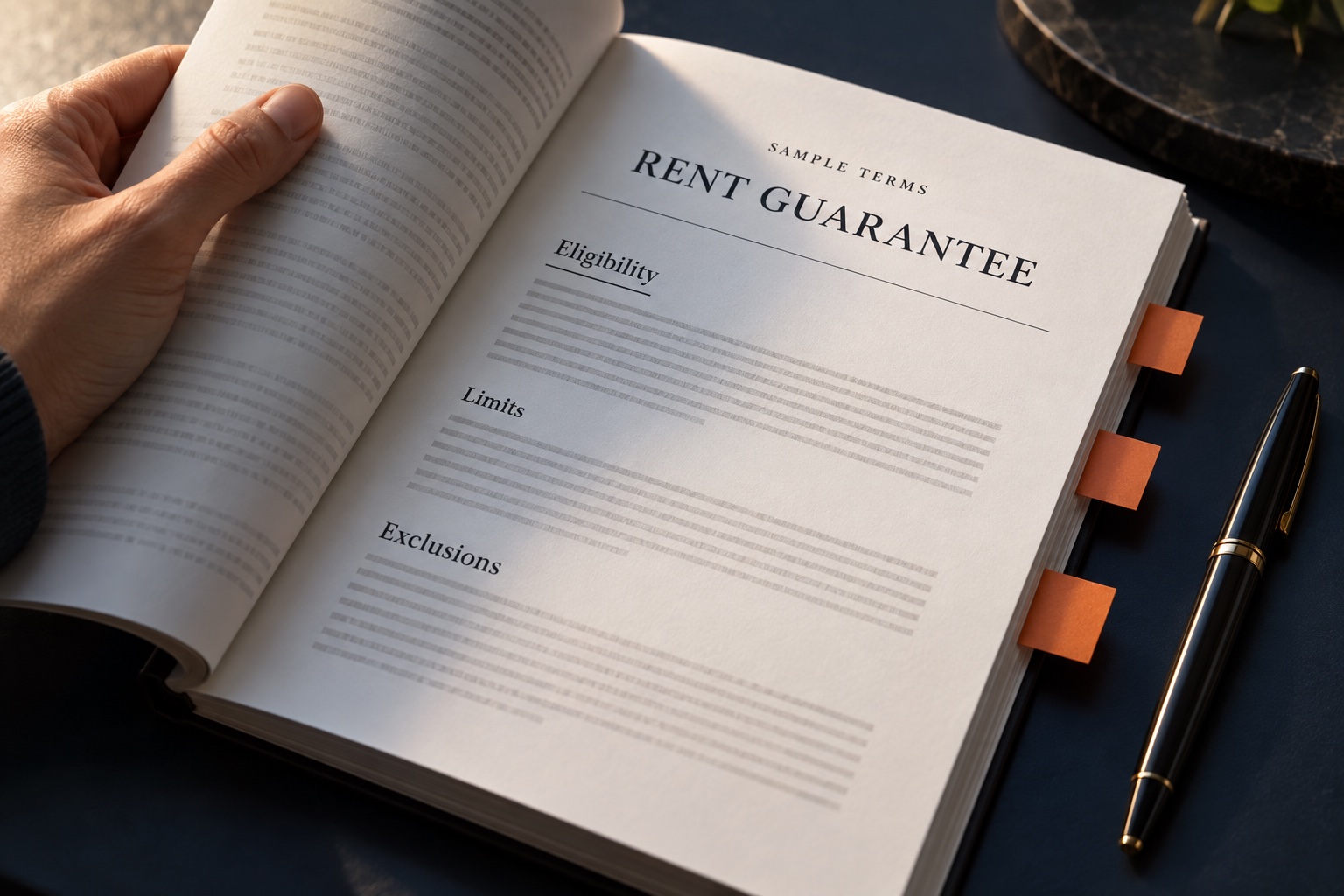
Rent guarantee property management Ontario: 8 due-diligence questions to ask providers before signing. Understand coverage, exclusions, and claims.
A rent-guarantee service can sound reassuring when a missed payment would put pressure on your property's cash flow. Before deciding, find out exactly what the arrangement promises, who is responsible for that promise and which conditions apply.
The words “rent guarantee” do not, by themselves, describe a standard level of protection. Do not assume that every service is insurance, or that none is. Ask the provider to explain the structure and supply the complete written terms.
The questions below are a due-diligence checklist, not a recommendation for a particular product or legal or financial advice.
1. Who provides the protection?
Identify the legal entity responsible for paying a valid claim and its relationship with the property manager. Ask whether another provider or insurer is involved and where you can verify any relevant authorization or policy documentation.
Make sure the name on the agreement matches the party whose obligations are being described. A sales summary is not a substitute for understanding the actual agreement.
2. Is my property and tenancy eligible?
Describe the property and current tenancy accurately. Ask whether the service accepts existing tenancies, new placements, different property types or a tenancy with a history of missed payments.
Confirm when any protection begins and what needs to happen before it becomes active. Obtain written confirmation of the arrangement offered for your property rather than assuming that a general advertisement establishes eligibility.
3. What events are covered—and excluded?
Ask the provider to explain full non-payment, partial payment, vacancy and property damage separately. They are different situations and should not be treated as interchangeable.
Request examples of a covered and an excluded situation. Check whether changes in the tenancy, management arrangement or ownership affect eligibility. If a term is unclear, ask for clarification before signing.
4. What limits and timing apply?
Confirm any payment cap, maximum duration, waiting period, deductible or other limit. Ask whether payment is an advance, a reimbursement or another arrangement, and what must happen before funds are released.
Consider the practical cash-flow gap between a missed payment and a potential payout. A service with a payment limit or a long process may not remove the need for a financial reserve. Obtain advice appropriate to your circumstances when evaluating that risk.
5. What must the owner or manager do?
Request a written list of ongoing responsibilities and claim requirements. These may concern records, communication or other agreed procedures; do not infer them from the product name.
If requirements involve tenant selection, notices, disputes or enforcement, check them with a qualified professional. A provider's instruction does not replace applicable law, and a checklist should not be used to decide a resident's rights or eligibility.
Clarify who performs each task and who checks that it has been completed. Shared responsibility can otherwise become unclear responsibility.
6. What records support a claim?
Ask which records are needed, how they should be submitted and which deadlines apply. Confirm how to contact the provider if a claim is incomplete or disputed.
Keep relevant records organized and protect residents' personal information. Only collect and share information needed for a legitimate purpose, using suitable access controls and professional advice where necessary.
Owner reporting can help you locate financial records, but a portal alone does not establish that a claim meets the provider's requirements.
7. What is the full cost and exit process?
Request all fees, renewal terms and cancellation provisions. Ask what happens if you sell the property, change managers or stop using the service. Confirm whether an existing claim is affected when an agreement ends.
Compare the complete arrangement—not just the advertised benefit—with your needs, management scope and other protection you already have.
Bring these questions to a property-management discussion
Atalla Group offers rent-guarantee services as part of its service offering. Availability, eligibility and protection depend on the particular arrangement and its written terms; this article does not promise acceptance or payment for every loss.
A useful discussion should leave you able to explain who provides the service, what qualifies, what is excluded, what you must do and what it costs. If you cannot explain those points, pause and obtain clarification.
Want to understand the options for your rental property? Request a free property-management assessment and ask which rent-guarantee arrangements may be available for your situation.